Most period trackers, and femtech products in general, share the same look and feel: pink color palettes, a single body type, and default references to white and cis-gender women. Euki has always aimed to fill the gap in these products, setting out to build a free period tracker and reproductive health tool that is radically inclusive and deeply human. Some of that work lives in the app's research-backed educational library, which offers evidence-based information without reinforcing stereotypes. But much of it lives in what users see on every screen: the illustrations created by Euki's brilliant designer, Ania, who has been with Euki since before it even had a name.
In contrast to a tech landscape built on stock images and templated icons, every illustration in the Euki App, on our website, and across our materials is drawn by hand. Behind each one is a story, a metaphor, and a deliberate choice about who gets to see themselves reflected. Ania's work is rooted in the same vision that drives Euki: a world where everyone has private, secure access to the information and tools they need to live healthy, safe, and pleasurable lives; free from sexual, reproductive, and gender-based repression and stigma.
This week’s blog is all about Ania, and how her work meaningfully shapes the user-experience of the Euki App.
Q: When did you first start drawing?
A: I'm from Poland and grew up there, and even in this funny photo album of when I was a child, there's a photo of me on a pile of sand with crayons and a piece of paper, and my mom wrote a caption under it that said something like, "Ania draws under any circumstances, in any condition." I don't have many memories of drawing, but I do remember that I could draw realistic humans very early on. Maybe that's connected to the fact that I have aphantasia, which means I don't have mental images.
Q: Wait, what? How does that shape the way you make art?
A: I have zero mental images. So if I don't draw something, I will never see what I'm imagining. I have to draw. Some people with aphantasia never draw because they're discouraged; they cannot imagine themselves being artists. But a big chunk of artists have aphantasia because they're so obsessed with actually seeing what they're imagining. There are ideas I'm thinking about and I want to see them, but I cannot see them in my mind. It's a concept, and you have to make it real on paper to see it.
Q: What does having Aphantasia feel like?
A: I don't know any other way of being, so I can't compare it to having mental images. But I'm also not bound by being disappointed with what I'm seeing, because I don't have anything to compare it to. So it's nice not to have the mental image, because whatever is on the paper is what it is, and I accept it for what it is. Having a mental image can actually be disappointing when people's abilities don't match their vision, but I'm free from that. I draw because I love it and I want to see what comes out. That's why I do ceramics, because you put something into 3D, which is even more exciting.
Having something tangible always felt really important to me, and that ties to the Euki App. Apps these days are usually very digital, and a lot of brands choose to use generic, ready-to-go icons downloaded from stock sites, something that already exists. But we wanted to make something human and tangible, so we decided to make sure its elements were hand-drawn, human, instead of geometric and perfect. That's why, for example, the tracking icons don't have perfect circles. The icons have edges that are visually imperfect on purpose, to make them more human and relatable.
Q: How do you think that translates into the Euki App user experience?
A: We also bounce things off the User Advisory Team, so it's not entirely my choice. I bring the human skill I have to create something. With icons and illustrations, there's a very gentle dance, a balancing act. As a creator, you want to make sure it's easily understandable, so it uses metaphors and common concepts people understand. But we also can't fall into stereotypes in our culture that could be exclusionary, hurtful, untrue, or devaluing of some people's experiences. So there was always a lot of consideration in making something relatable. It's not only that it's drawn by hand and imperfect, but also: how do we use metaphors and concepts that are quick to grasp without being rooted in things that could be hurtful or triggering for people?
Q: Can you give us an example of a design where you worked through that balance?
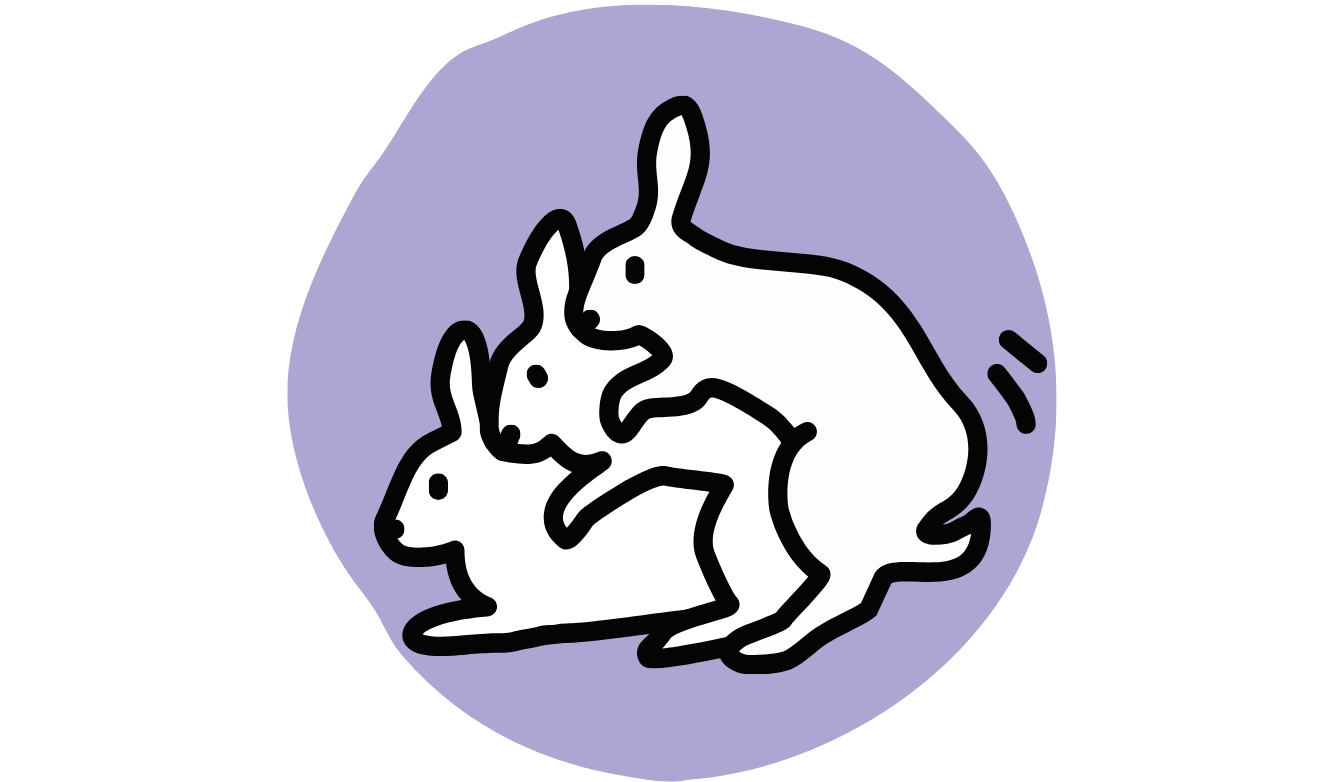
A: The Euki App’s body icons. We didn't want to portray specific things; they were supposed to be more like concepts. For example, using a brown color that sits somewhere within the true spectrum of human skin tones instead of defaulting to a lighter tone. That's one. Another is vaginal sex, or sexual activity generally: not showing whether it's female or male, even though you're talking about genitals. For an upcoming feature, we’re using rabbits as a metaphor for sexual freedom, in a way that isn't bound by human ideas of right or wrong, or by it being two people having sex, or by what gender they are. (Keep an eye out for the rabbits, coming soon to the Euki App!)
Q: And it results in something that feels so playful and engaging. Was it surprising for you how much of a hit the bunnies are? Everyone's obsessed with them.
A: Well, I'm obsessed with bunnies myself. I'm a bunny rescue activist. It's not a surprise, because they're magical creatures. But they actually break from the convention of showing an icon as a blob or a human face, because we wanted to show the freedom of it instead of defaulting to a precise configuration. The bunnies were the cherry on top of the playfulness. And I'm very happy they've gotten traction, because who doesn't like bunnies?
Q: I'm curious to learn more about your career path. You're an independent, free artist making things for yourself, and you've also moved into this digital space with Euki and worked with other mission-driven organizations related to menstrual health and products. How did you get started there, and why is that intersection important?
A: I'm always in between in my life: between continents, between my practices. One is strictly art for my soul, things I need to do for myself. But I don't think I would be happy as a person only concerned with my own visions. I have a need to help others. Actually, I wouldn't even say I'm in between. I'm always planted with both legs on two different things. One leg stands in fine arts, where I'm free in what I put out. The other leg is always about serving and helping. That's why my activism is both digital and very hands-on, like when I do rabbit rescues. I have this need to make sure I don't get depressed about the current state of the world. I want to do something about it. So my other leg is always activism. And if my skill, what I can give to the world, is art, then let it be design that's adjacent. Something where I can put my skills to work while intentionally thinking about who it serves, how it serves people, and what world I'm building with my skills.
Q: That's beautiful. I think anyone who has met you would remark on how strong of an activist you are. How did you begin your activist journey?
A: I think it's the default of my soul. When you know your intentions, opportunities find you. I'm always very clear about how I align myself in the world and what's important to me. Whenever I have conversations with people, I always make it clear where I stand on things. That’s how I got connected to Ana (Euki’s Executive Director and former Euki Project Director at Ibis Reproductive Health) [back in 2017]. I was meeting people and telling them what I did, and one of them was someone who worked at Ibis Reproductive Health, and she said, "Somebody's looking for someone with your skills." That was at the very early stage, I was brainstorming Euki as a name and what the app could look like, but the content was already clear from the research they had done.
Q: How has your own life shaped the causes you design for?
A: I had kids pretty early on. We lived in Poland and felt really rooted there, but we also needed a challenge. There was also the political situation. The right wing was taking over the judiciary and the whole landscape, and started scapegoating LGBTQ people. My best friend is queer, and I've always felt gender nonconforming, and all of that made me feel I didn't want my kids to grow up there. Then I came to the US and the same script followed. We moved to make sure we could give our kids more freedom in how to live, and not be tied to just one way of living.
I have so many threads in my life, and they need to weave into who I am. One is being head of design at a company that does a lot of pro bono work, like short booklets about panic attacks, menopause, and breast cancer. That's very mission-driven. But we also make packaging for over-the-counter medicine like ibuprofen, things people have in their homes. In the majority of homes in Poland, people have a piece of my design. People touch my skills whenever they want to self-manage symptoms in their bodies.
And that connects to Euki. We also give people agency to make informed choices about their health, like abortion or contraception. It doesn't have to be the packaging of the medicine they order. It can be something that tells them: don't worry, you're safe, we've got you. It's about how to show care.
Thank you for all that you do, Ania. It's the creative thinking and spirit like yours that make both the Euki team and the Euki App so unique.